‘Hagia Sophia / Sanctum of Kronos’ by Peter Mark Adams
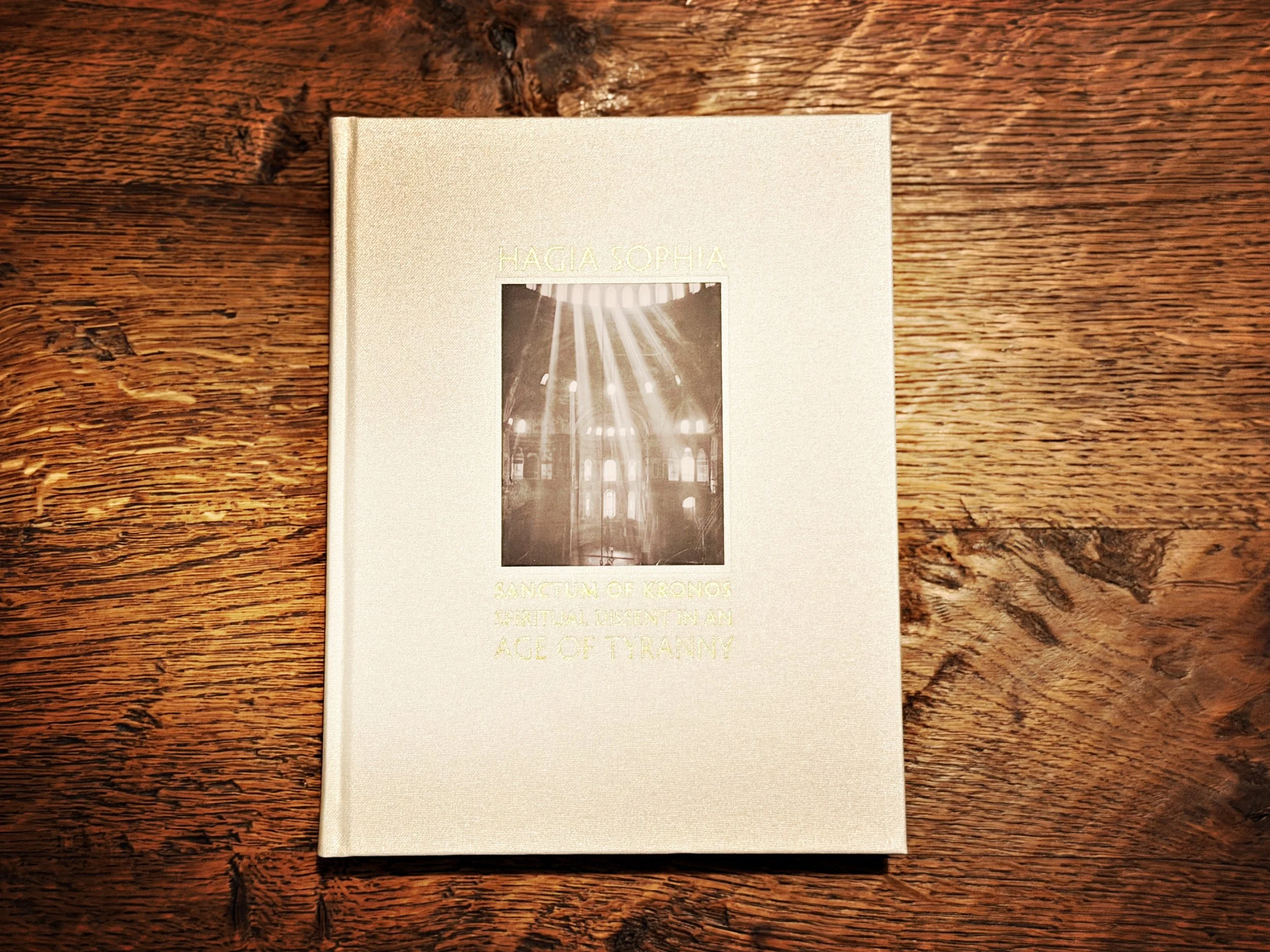
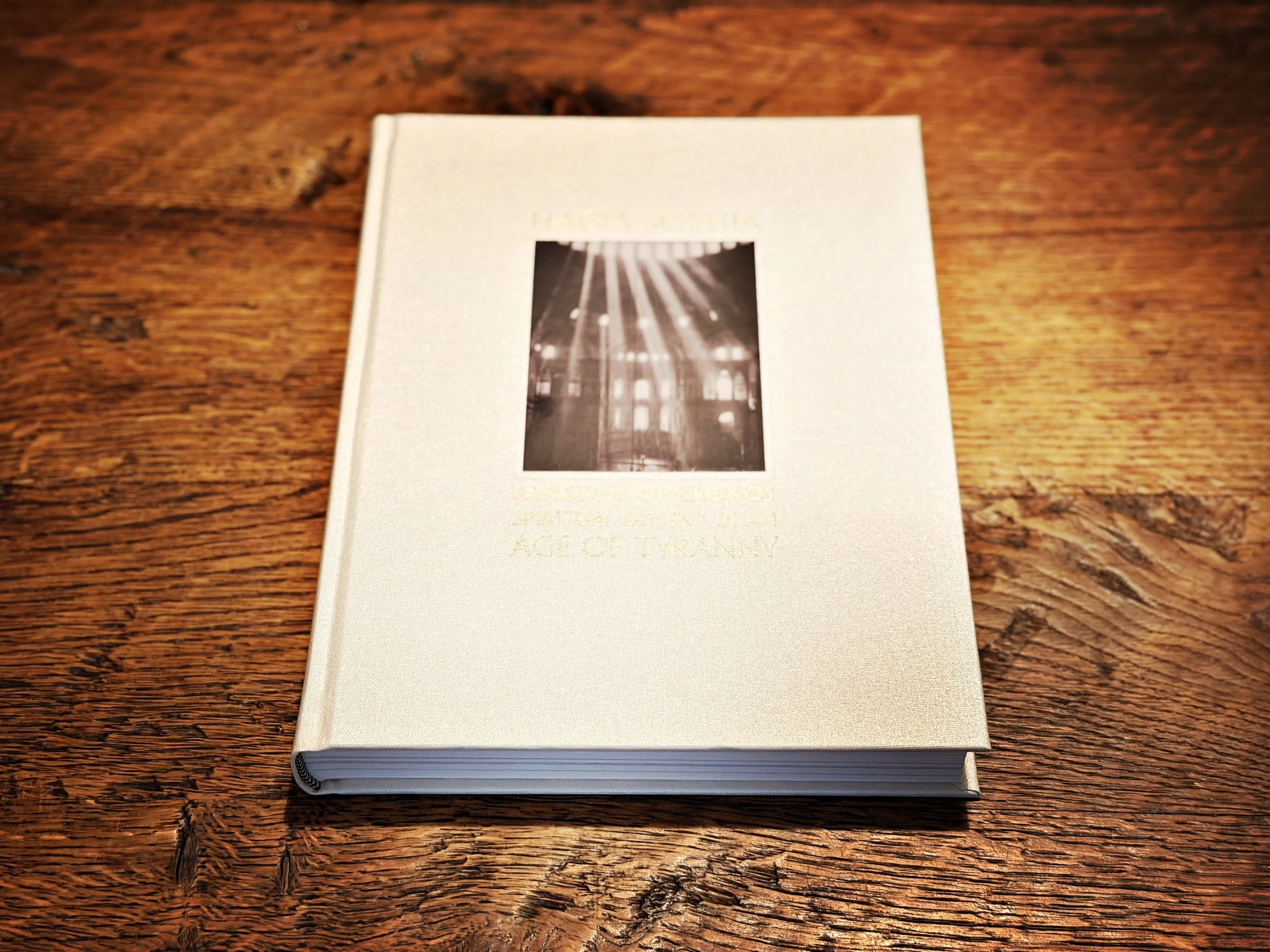
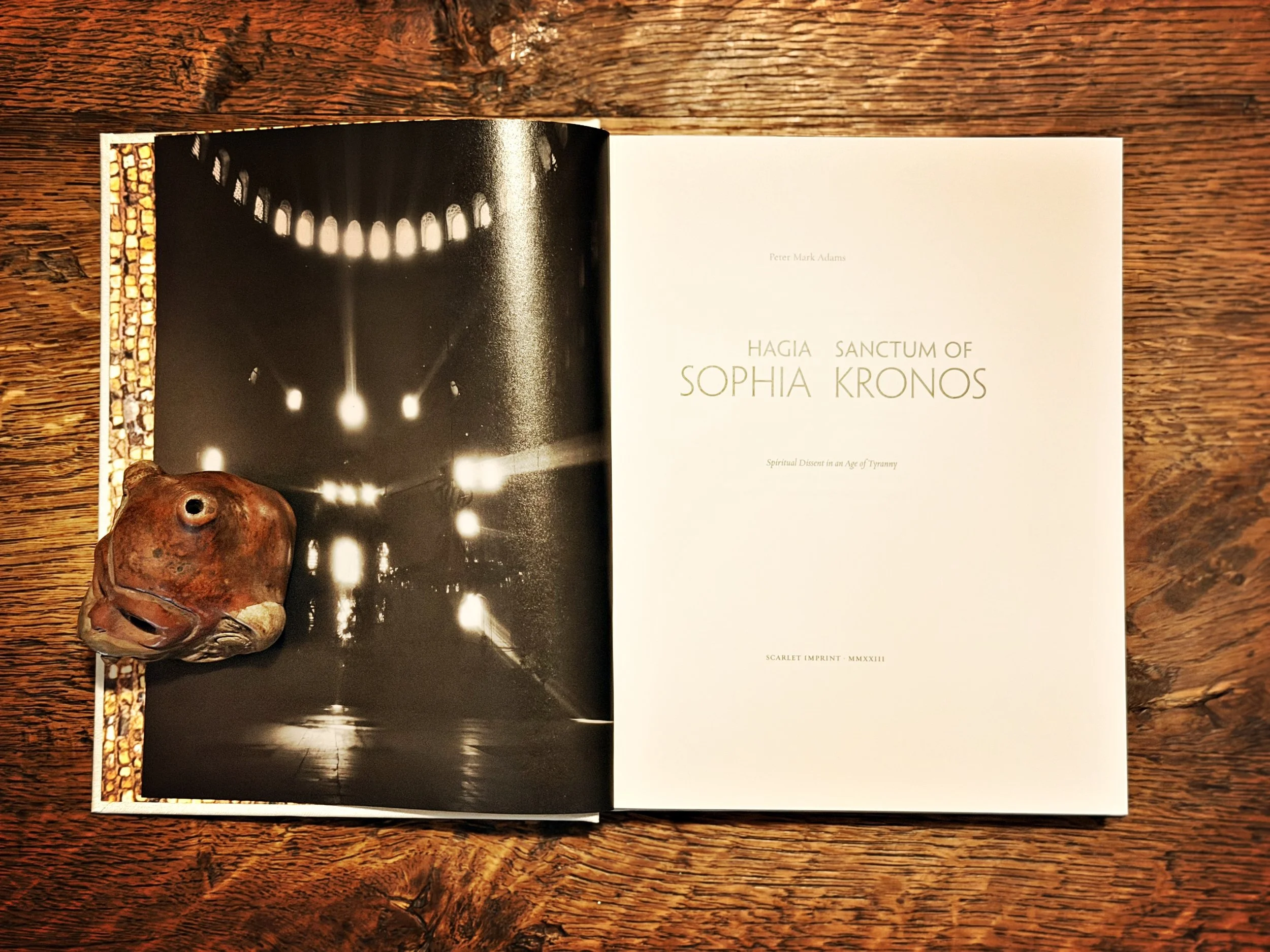
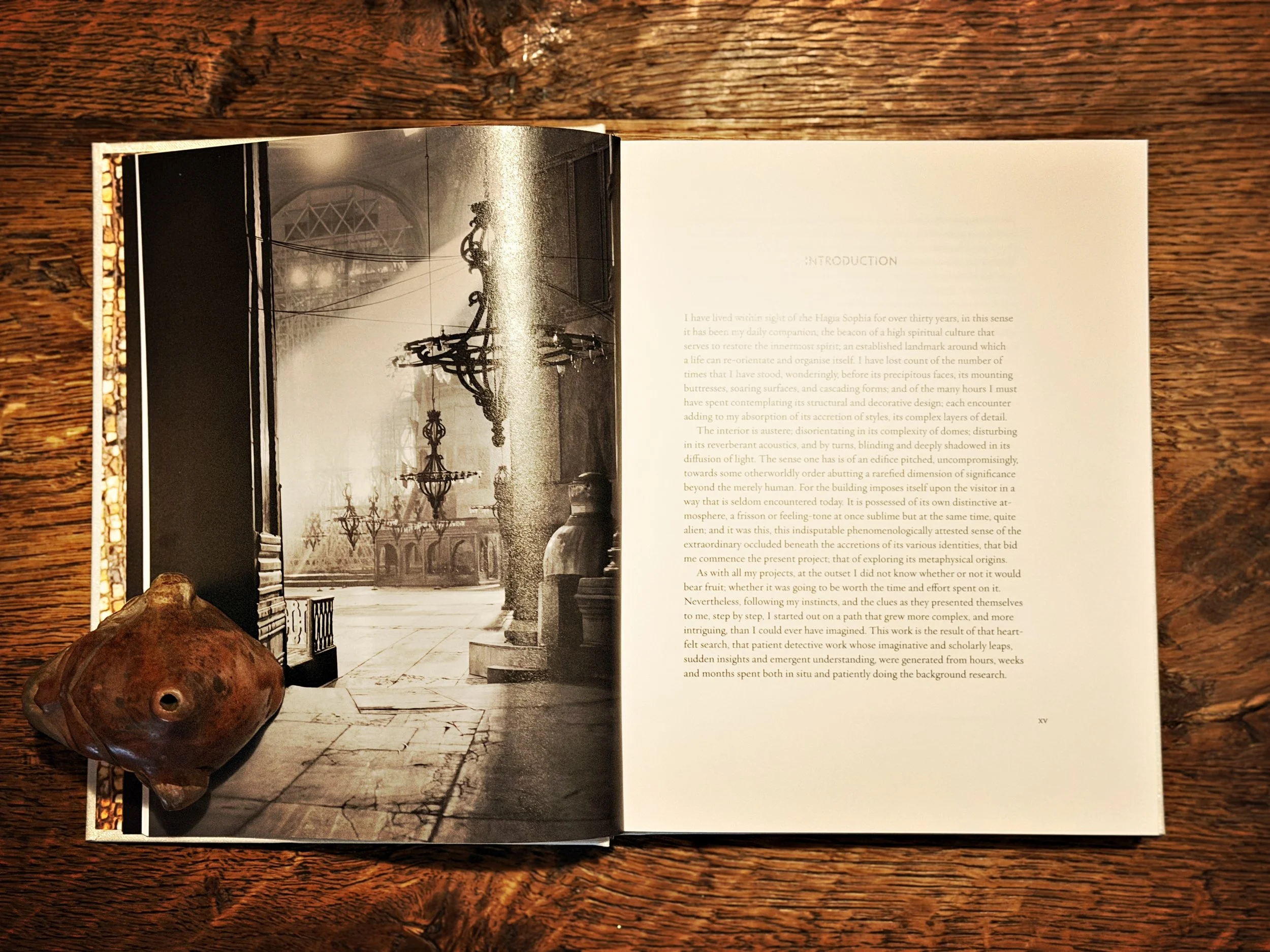
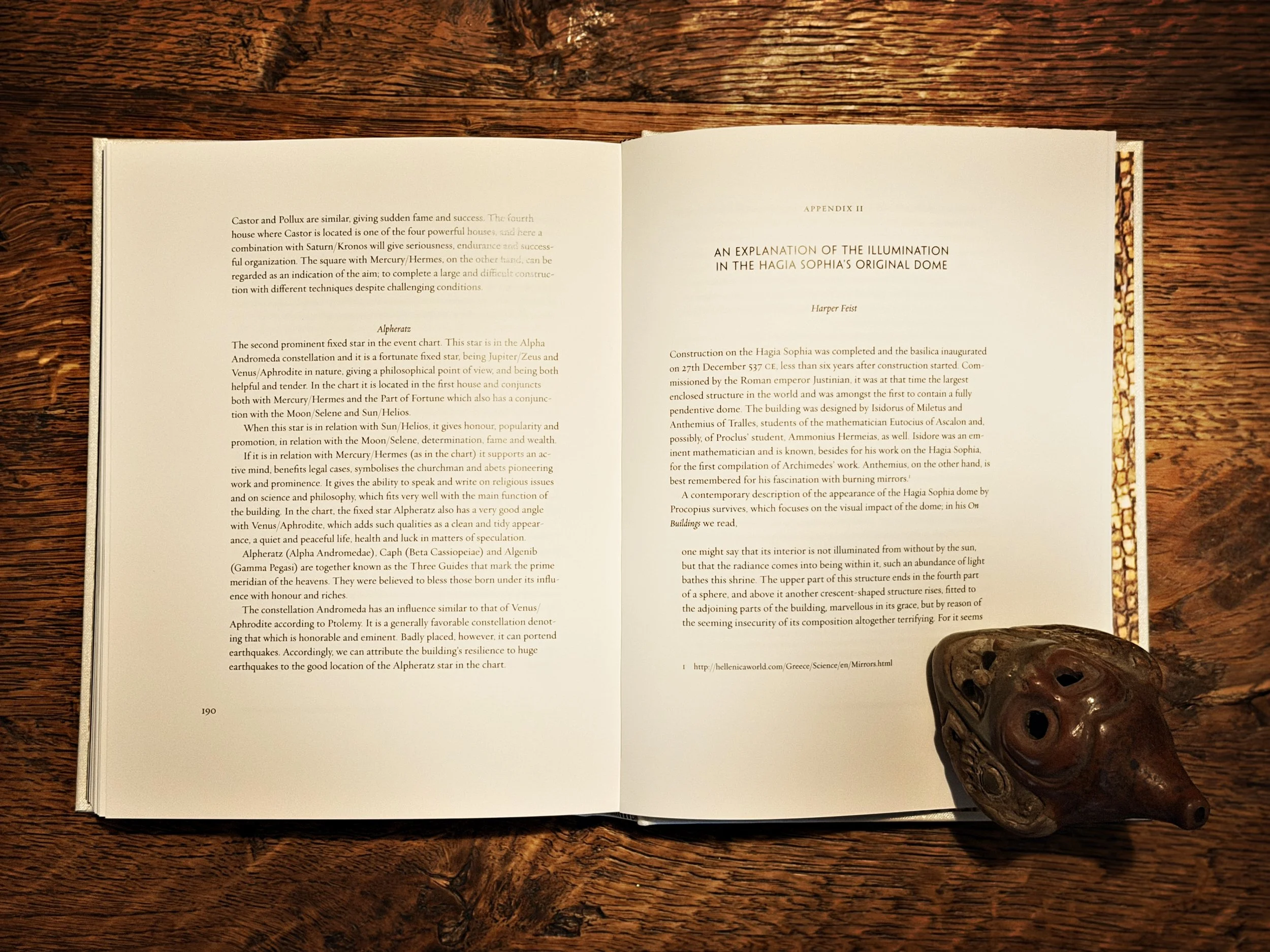
Peter Mark Adams, Hagia Sophia / Sanctum of Kronos: Spiritual Dissent in an Age of Tyranny, London: Scarlet Imprint, 2023
Review by Dr. Nat Clegg
Holy Wisdom, Hidden Agenda
There is a specific kind of scholarly courage required to look at one of the world's most photographed and theorised buildings and declare, calmly and with formidable evidential backing, that virtually everyone has been looking at it wrong. Peter Mark Adams possesses that courage in abundance. Having spent three decades living within sight of the Hagia Sophia, he brings to this book not merely academic rigour but something rarer: the accumulated patience of proximity, the slow accumulation of phenomenological knowing that only long residence in the presence of a place can produce. The result is the most genuinely revelatory study of sacred architecture to appear in English in a considerable time.
The central argument is audacious. Adams contends that the Hagia Sophia, consecrated in 537 CE under the Emperor Justinian, was not the triumphant monument to imperial Christianity its commissioners imagined it to be, but precisely the opposite: a covert act of metaphysical resistance encoded in stone, geometry, resonance, and light by architects and theorists who were initiates of the dying Hellenistic mystery traditions. The building, he argues, is a three-dimensional talisman, a life-sized mandala crystallising the core metaphysics of the Eleusinian tradition at the precise historical moment when that tradition was being systematically destroyed by imperial decree. This is Fulcanelli's thesis for the Gothic cathedrals, but executed with far greater scholarly transparency and, it must be said, considerably more persuasive evidence.
Part One: The Golden Chain
The book opens by establishing what Adams calls the “golden chain” of initiatic succession: the unbroken lineage running from Eleusis through the school of Athens, to Alexandria, and thence to the Ionian cities of Tralles, Miletus and Aphrodisias, from which the principal architects of the Hagia Sophia, Isidore of Miletus and Anthemius of Tralles, ultimately derived their intellectual formation. This is not the easy genealogy of intellectual influence one finds in conventional histories of late antique philosophy. Adams is careful to distinguish between the exoteric transmission of Platonic and Neoplatonic ideas and the initiatic, embodied transmission of theurgic practice. The distinction matters enormously to his argument, and he handles it with precision.
The chapter on the Rites of Eleusis is amongst the finest short accounts of the Eleusinian tradition available to the general reader. Adams avoids the twin temptations of over-literalism and mystifying vagueness, arriving instead at a clear functional account of what the mysteries were attempting to accomplish in terms of consciousness, cosmology, and the purification of what Hierocles of Alexandria termed the “luminous body.” This sets the metaphysical ground for everything that follows.
The chapter on Asclepigenia, the last Eleusinian priestess, is quietly devastating. Her figure, largely absent from mainstream accounts of the period, carries the full weight of the tradition into the fifth century and, through her student Proclus, into the network that would eventually produce the Hagia Sophia’s designers. That such a lineage could be transmitted through a single woman, operating under conditions of active imperial persecution, and then survive to find expression in a building constructed under the nose of the very regime that sought to eradicate it, is one of those pieces of history that reads like myth and yet is demonstrably factual.
Part Two: The Building Itself
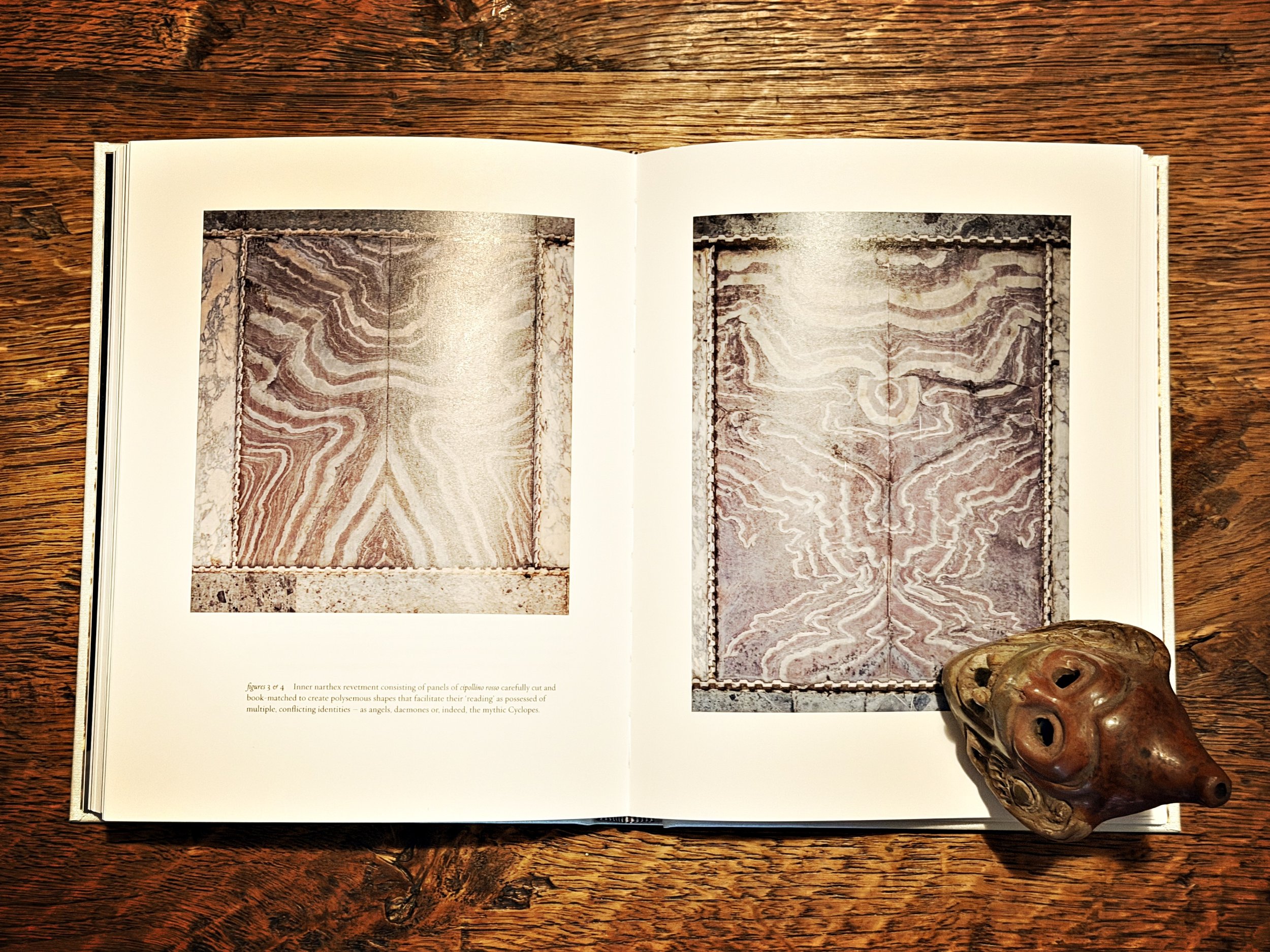
The second half of the book turns to the fabric of the structure, and here Adams is at his most original and most demanding. The chapter on the marble revetment is extraordinary. Where conventional art history sees decorative cladding, Adams identifies a deliberately theurgic programme in the selection, orientation, and figural suggestion of the variegated marble panels. The hybrid forms that appear within the stone’s natural patterning are not accidents of geology enthusiastically interpreted; they are, Adams argues, intentional invocations of the chthonic and liminal powers associated with the Saturnian and Kronion aspects of the tradition. One may or may not be wholly persuaded, but the argument is careful and the visual evidence, supported by the specially commissioned colour photographs, is genuinely striking.
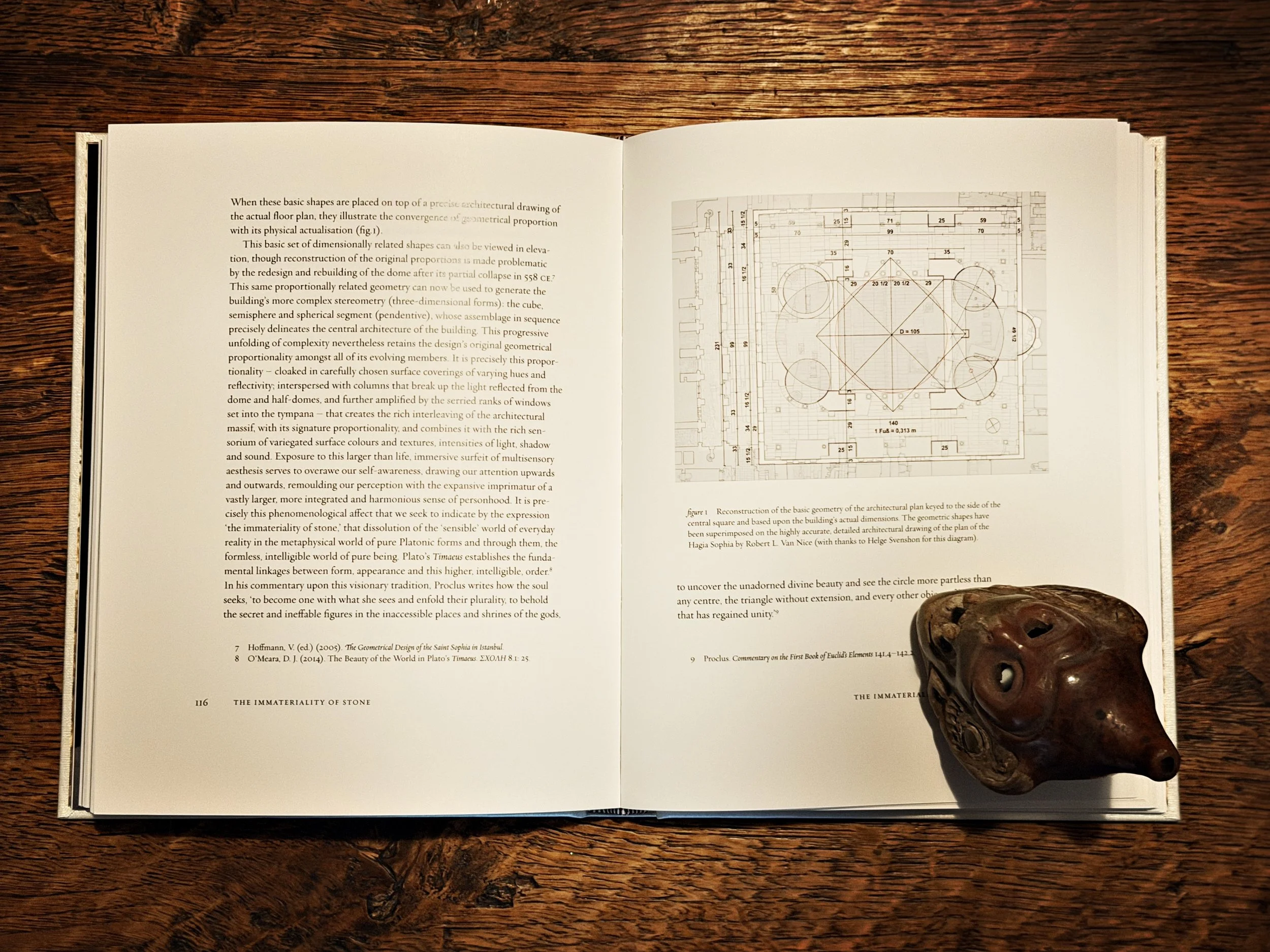
The chapters on light, geometry, and harmonic ratio are dense but reward the patient reader. Adams draws on the mathematical and theurgic writings of Iamblichus and Proclus to demonstrate that the proportional systems governing the building's interior spaces were not simply aesthetic choices but corresponded to a cosmological schema in which the philosopher-initiate, standing within the nave, would be positioned at the axial point of a geometrically encoded universe. The dome’s relationship to the sun and the seasonal calibration of light through the clerestory windows are shown to function as a kind of permanent theurgic mechanism, animating the building's talismanic programme at specific cosmological moments.
The chapter on the Face of Tyranny and Spiritual Dissent is perhaps the most immediately contemporary section of the book, and Adams does not press the parallels too insistently, which makes them more pointed. His portrait of Justinian’s reign as a climate of widespread fear, surveillance, forced conformity, and intellectual self-censorship is historically meticulous and quietly chilling. The response of the Hellenist underground, to encode their entire metaphysical worldview into the fabric of the regime's most prestigious building project, emerges as one of history's more elegant acts of resistance.
Appendices and Apparatus
The two appendices are substantial contributions in their own right. Gamze Güzen's astrological elective reading for the 532 CE commencement of construction is a serious piece of technical astrology that deserves attention from practitioners, demonstrating a coherence between the chosen electional chart and the theurgic objectives Adams identifies in the building itself. Harper Feist’s technical analysis of the original dome’s design and reflective properties provides the architecturally precise underpinning for Adams’ claims about the building’s optical programme.
A Note on the Work as a Whole
This is Adams’ third volume in a sequence that began with The Game of Saturn and continued through Mystai, and it is arguably the most accessible of the three, insofar as the Hagia Sophia offers a more familiar cultural entry point than the Sola-Busca Tarocchi or the Dionysian frescoes of Pompeii. That said, “accessible” is relative. Adams writes with precision and erudition, and readers who come to the book without some prior acquaintance with Neoplatonic philosophy, late antique history, or the principles of sacred geometry will need patience and a willingness to use the generous glossary.
For those who do bring that preparation, or who are willing to acquire it, this is a work of the first importance. It relocates one of the world's great monuments within a tradition of living spiritual practice rather than dead religious history, and it does so through argument rather than assertion. The prose itself is considerable: lapidary, precise, genuinely atmospheric in its descriptive passages, and entirely free of the hedging and qualification that so often drains esoteric scholarship of its force.
Hagia Sophia / Sanctum of Kronos is not a comfortable read. It asks serious things of its reader and offers serious rewards in return. In its argument that spiritual traditions can survive, even thrive, by encoding themselves within the structures of the very powers that seek to suppress them, it speaks to concerns that are anything but antiquarian. That may be the most important thing about it.
Scholarly Resonance and Further Horizons
Readership and Academic Utility
It would be tempting to file this book under “esoteric studies” and leave it there, but that would be a considerable disservice both to Adams and to the several academic communities for whom it constitutes genuinely useful primary scholarship. The book sits at the productive intersection of a number of fields that rarely speak to one another with any seriousness, and its value differs meaningfully depending on the discipline from which one approaches it.
For scholars working in the history of late antique religion, and particularly those engaged with the question of how Hellenistic and Neoplatonic traditions responded to Christianisation, this book offers a compelling case study in covert transmission. The historical material in the first part of the volume is rigorous enough to stand alongside mainstream academic work in the field, and Adams’ tracing of the initiatic network from Eleusis through Athens, Alexandria and Asia Minor provides a usable genealogy that historians of religion will want to examine, contest, or build upon. Scholars working on figures such as Proclus, Iamblichus, Damascius, and the school of Alexandria will find Adams’ framing of their theurgic doctrine as a living and adaptive practice, rather than a philosophical relic, a genuinely provocative contribution to ongoing debates about the nature and scope of late antique paganism.
The architectural history community has, broadly speaking, been reluctant to engage with esoteric interpretations of sacred buildings. The comparison with Fulcanelli’s work on the Gothic cathedrals is instructive here: whatever one makes of Fulcanelli’s conclusions, his influence on French architectural thought was real and lasting, yet Anglo-American architectural history has largely kept such approaches at arm’s length. Adams’ scholarly apparatus, his grounding in primary sources, his engagement with the specialist literature on Byzantine construction, and the technical rigour of Harper Feist’s appendix on the dome’s optical properties, make dismissal considerably more difficult than it might otherwise be. Architectural historians working on Hagia Sophia specifically, and on the relationship between proportion, geometry, and cosmology in Byzantine sacred building more broadly, will find both a challenge and a resource here.
For scholars in the emerging field of cognitive science of religion, and particularly those interested in how built environments shape and induce states of consciousness, the book offers a sophisticated historical case study in intentional architectural design for altered cognitive experience. Adams’ account of the building as a theurgic mechanism, calibrated to move the practitioner through specific stages of contemplative and visionary experience, maps interestingly onto contemporary research in neuroarchitecture and the phenomenology of sacred space. Researchers such as those working within the framework of Thomas Metzinger’s phenomenal self-model, or the cognitive archaeology of consciousness associated with David Lewis-Williams, would find much to engage with here, even if Adams’ own theoretical vocabulary is Neoplatonic rather than neuroscientific.
Scholars of Western esotericism, whether working in the academic tradition established by Antoine Faivre and developed through the journals associated with the European Society for the Study of Western Esotericism (ESSWE), will recognise this book as an important contribution to the long-running question of continuity and rupture in the transmission of esoteric traditions. Adams’ treatment of the “golden chain” concept addresses, in a rigorous historical context, precisely the kind of transmissional claim that ESSWE-affiliated scholars have tended to approach with scepticism. His argument does not require acceptance of the metaphysical claims themselves; what it requires, and what it earns, is a serious engagement with the historical evidence for a network of practitioners who believed in that chain and acted accordingly. The sociology of that belief, quite apart from its metaphysical validity, is a legitimate and largely unexplored area of late antique studies.
Gender studies and the history of women in religious life will find significant material in the chapter on Asclepigenia. The figure of the last Eleusinian priestess as the custodian of a thousand-year lineage, operating under conditions of imperial persecution and transmitting that lineage through her teaching, raises questions about the gendered structure of initiatic transmission in late antiquity that have received surprisingly little sustained attention. Adams does not foreground this dimension explicitly, but it is implicit throughout, and a feminist reading of his historical reconstruction would be both possible and productive.
Finally, and perhaps unexpectedly, the book has serious implications for scholars working in political philosophy and the history of ideas around dissent, resistance, and what one might call the politics of the sacred. Adams’ central thesis is, at its core, an argument about how subordinated intellectual and spiritual communities respond to hegemonic power: not through martyrdom or open confrontation, but through the patient encoding of their values within the very symbolic architecture of the dominant order. This is a strategy with obvious analogues throughout history, from the crypto-Judaism of the Marranos to the esoteric dimensions of Freemasonry, and it deserves theorisation beyond the specific historical case. Political theorists working on subaltern knowledge, counter-hegemonic practice, or the Gramscian concept of cultural resistance would find in Adams’ account a richly documented historical precedent.
Possible lines of further investigation
The book opens rather more questions than it closes, and that is very much to its credit. Several directions suggest themselves as natural extensions of Adams’ project.
The most immediate concerns the other great Justinianic building programme. If the Hagia Sophia encodes a covert theurgic agenda, the question of whether the same network of architects, theorists, and patrons introduced similar programmes into the other major ecclesiastical constructions of the period deserves systematic investigation. The churches of Saints Sergius and Bacchus in Constantinople, the Basilica of San Vitale in Ravenna, and the complex at Qal’at Sim’an all date from broadly the same period and involve overlapping networks of patronage and design. A comparative study along the lines Adams establishes here would be a major scholarly undertaking and one that might substantially revise the standard narrative of early Byzantine ecclesiastical architecture.
Second, and more speculatively, Adams’ reconstruction of the Alexandrian school’s theurgic doctrine as it applies to sacred architecture invites comparison with the better-documented Islamic tradition of sacred geometry and cosmological architecture. The great mosques and madrasas of the medieval Islamic world, and particularly those associated with philosophical and Sufi traditions, operate within a framework of sacred proportion, light management, and cosmological encoding that bears striking structural resemblances to what Adams describes. Whether this represents genuine historical transmission from late antique Hellenistic sources, parallel development from shared Platonic and Pythagorean roots, or something more complex, remains largely uninvestigated. The study of that relationship would require collaboration between scholars of late antique paganism, Byzantine Christianity, and Islamic intellectual history, which is precisely the kind of interdisciplinary project that rarely happens and invariably should.
Third, Adams’ focus is necessarily on a single building. The broader question of how initiatic communities across the late antique and early medieval world encoded their metaphysical worldviews in material culture, whether in textiles, mosaics, manuscript illumination, or domestic ritual objects, remains largely open. The field of what one might call “material theurgy,” the study of how theurgic doctrine translates into the properties and arrangement of physical objects, is barely nascent. Adams' methodological approach, taking seriously the claim that objects and spaces can function as talismans in a technically specific sense, and then working backwards from the object to reconstruct the doctrine it encodes, offers a model that could be applied far more widely.
Fourth, the appendix by Gamze Güzen raises the question of astrological electional practice in late antique building and ritual, which is itself a largely underdeveloped area. The technical astrology of the period, its relationship to theurgic practice, and its influence on the timing of significant undertakings, sacred and otherwise, deserves the kind of rigorous scholarly attention that has been largely withheld because of disciplinary squeamishness about the subject matter. Adams and Güzen demonstrate that the evidential basis for such investigation is richer than is commonly assumed.
Finally, and most broadly, this book is an implicit argument for the rehabilitation of phenomenological experience as a legitimate category of architectural analysis. Adams’ account of the Hagia Sophia’s spatial and optical effects as deliberately engineered states of consciousness points towards a methodology for the study of sacred architecture that takes seriously both the intentionality of designers and the lived experience of those who move through the spaces they create. This represents a significant departure from the purely iconographic or structural approaches that dominate the field, and its implications extend well beyond late antique studies. In an academic climate increasingly interested in the embodied and sensory dimensions of historical experience, it is a methodological contribution whose time has unquestionably come.