A World Never Ours Alone: Reflections on ‘Alien Clay’ and ‘The Black Pilgrimage’
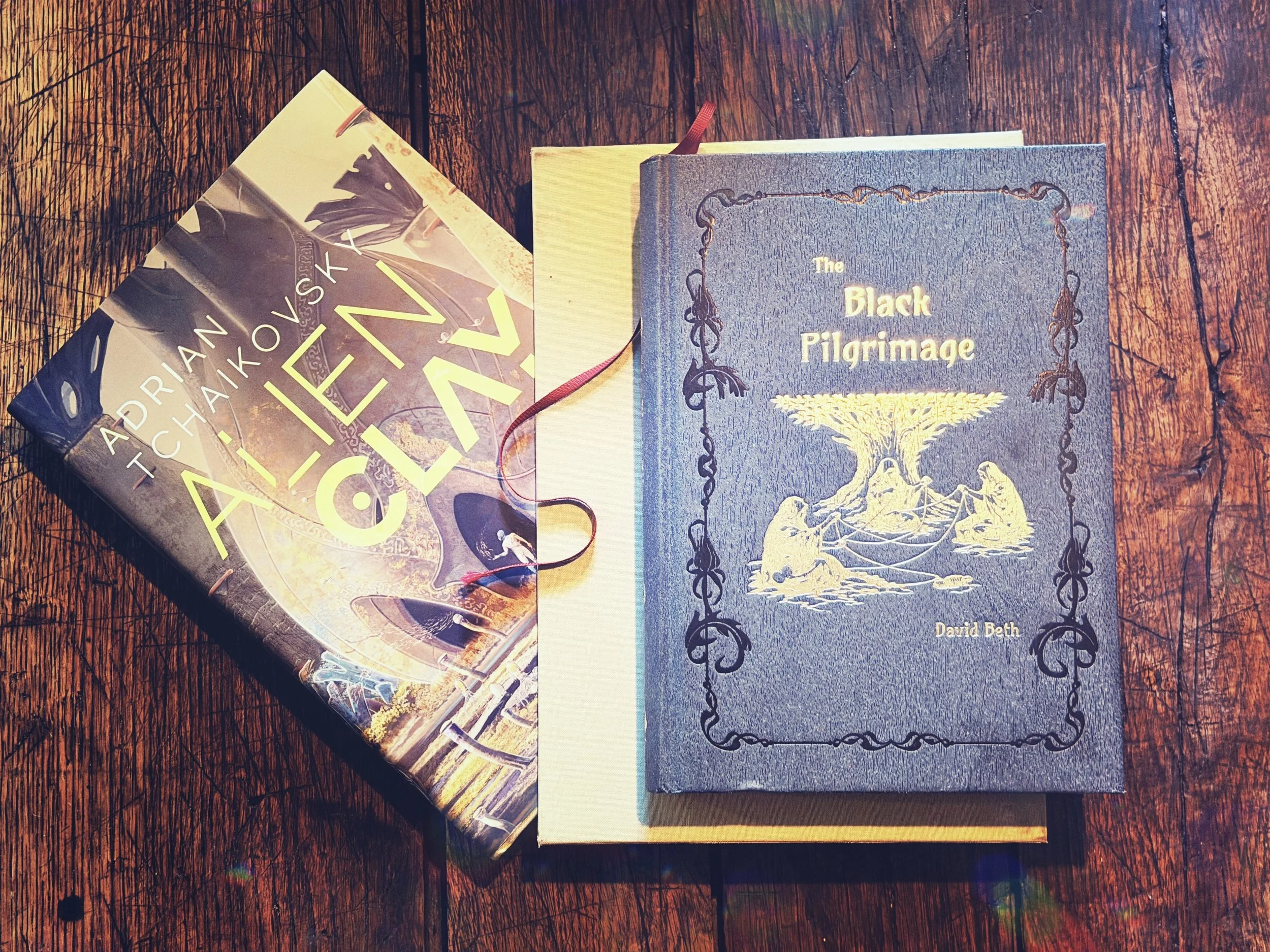
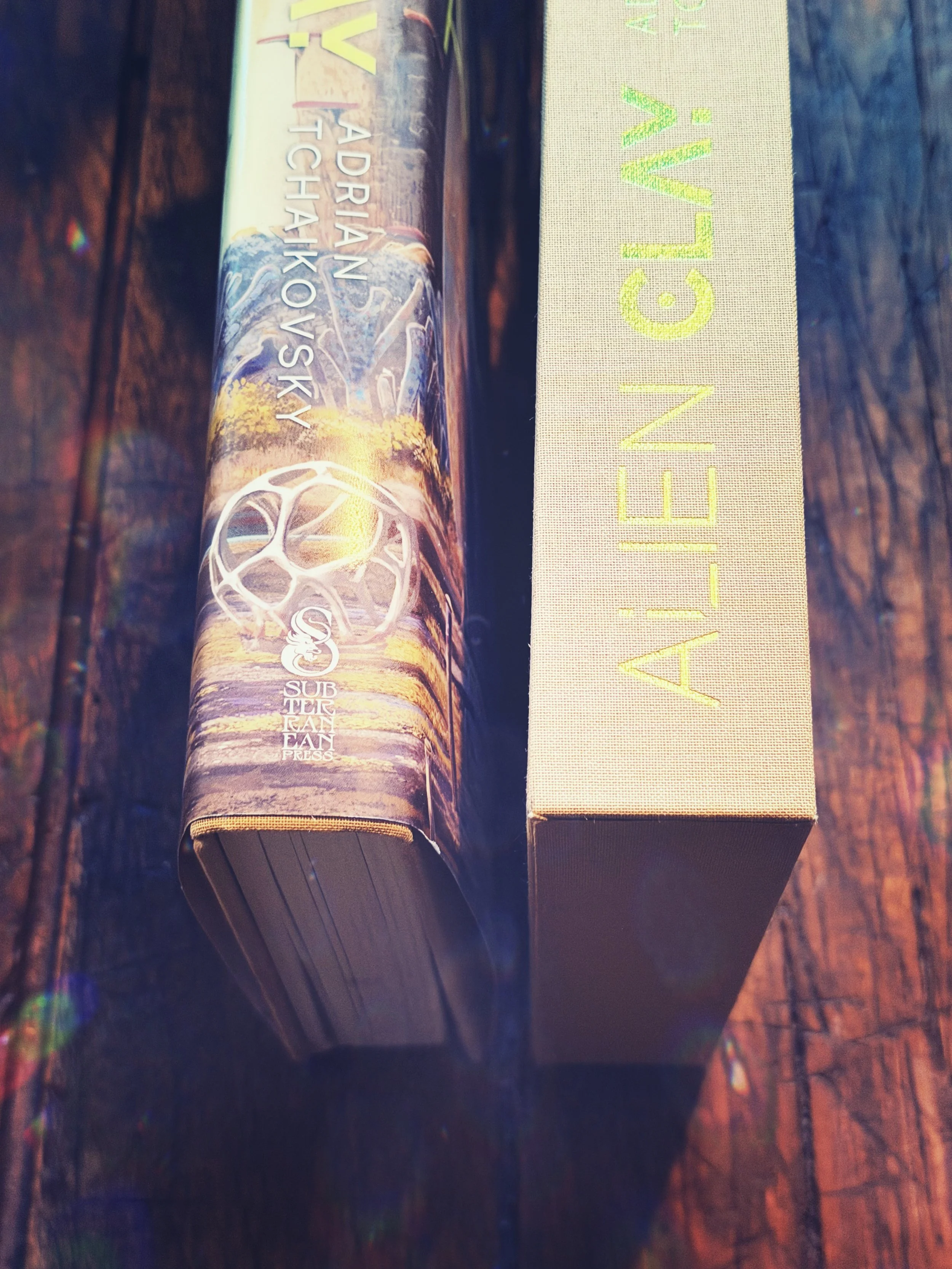
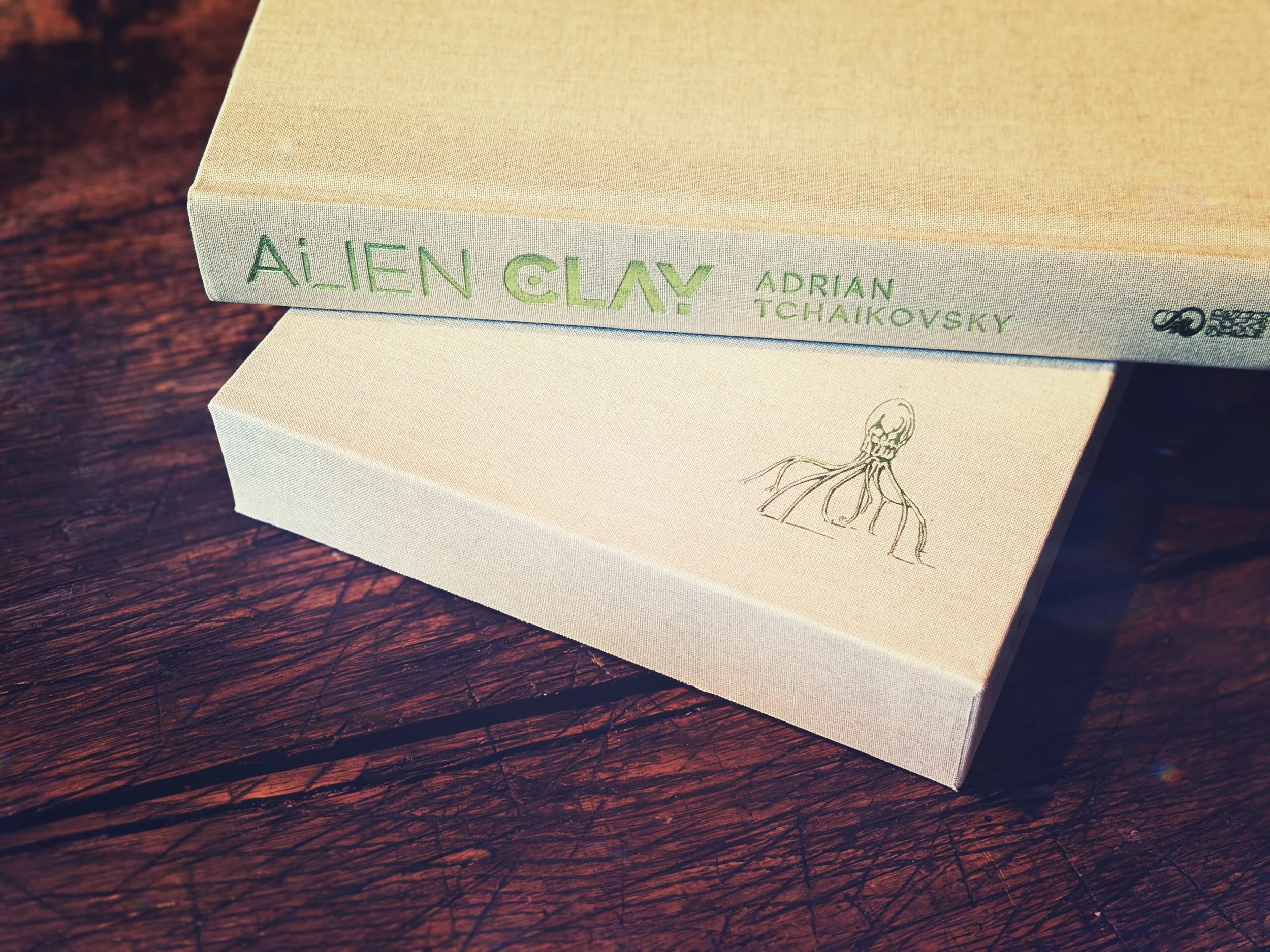
Adrian Tchaikovsky, Alien Clay, London: Tor Books, 2024.
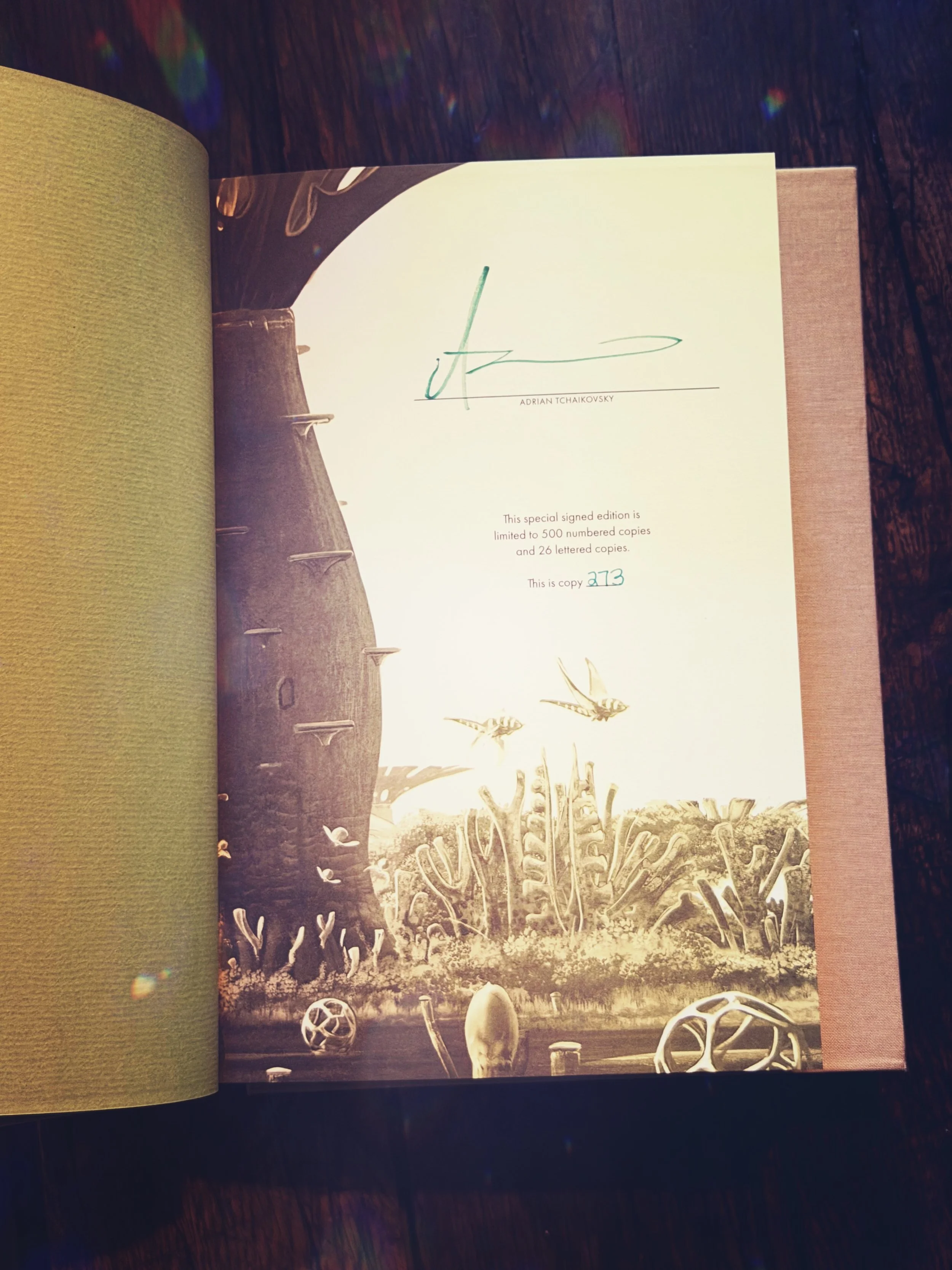
Reviewed here: Adrian Tchaikovsky, Alien Clay, cover illustration by Alex Ries, interior illustrations by Simon Roy, 500 signed numbered hardcovers, housed in a custom, foil-stamped slipcase, London: Subterranean Press, 2025.
Beth, David, The Black Pilgrimage, Munich: Theion Publishing, 2026.
Review by Frater Acher
I.
Some novels teach more than technical manuals on the same subject ever could. Gustav Meyrink’s The Angel of the West Window belongs to this order: a tale that conveys more about Enochian magic than many non-fiction books devoted to the topic. So do the novels of Dion Fortune, Maria Szepes’ incomparable The Red Lion, and Mark Z. Danielewski’s House of Leaves, which renders the threshold between architecture, perception, and terror more vividly than any specialist study.
Such books do not explain their subjects. They make them habitable. Once opened, they become spaces into which our senses expand.
By placing in our hands artfully fashioned testimonies of averred experience, they invite us to become witnesses ourselves: not merely to read, but to participate; not to observe a matter from without, but to undergo it from within. Their knowledge does not lie in assertion, but in the simulation of lived reality. They teach by transporting us into a world where what is learned no longer appears as two-dimensional information, but rises into three dimensions: atmosphere, places, presences.
Novels of this kind are as rare as they are subjective. Yet when we find them — or, more precisely, when they lodge themselves between our eyes — we feel them break through the walls of instruction. They draw us towards that legendary, now cobwebbed chamber once known as initiation.
A handbook tells us what to do. A good novel seduces our senses into believing we have already done it. A good work of scholarship extends our knowledge. A good novel changes the very place from which we experience the world. It does not merely teach the object. It hollows out a space in our senses through which the absence of that object can first be felt.
Adrian Tchaikovsky’s Alien Clay belongs to this lineage. It teaches more about ecology, xenobiology, colonial blindness, and the violence of classification than many abstract treatises on these subjects ever could. It does not merely describe an alien biosphere. It forces the reader to inhabit the collapse of human taxonomy before an intelligence that is neither machine, nor animal, nor god, but something still more humiliating to our categories: life organized, and constantly re-organizing, otherwise.
The book begins brutally, without prologue, plunging us into a scene of existential violence: A one-way spacecraft disintegrates by design upon entry into the atmosphere of a strange planet: Imno 27G, nicknamed Kiln. Like seeds cast from a bursting husk, a cloud of cryo-sleep chambers is scattered across Kiln’s sky, while their unwilling passengers awaken, and many die, in free fall.
A cacophony of vibration coming through the curved surface to you: the death throes of the vessel which has carried you all this way, out into the void, and is now fragmenting. There’s a world below that you know nothing about, not in your head right then. And above you are only the killing fields of space. The fact there’s a below and an above shows that the planet’s already won that particular battle over your soul and you’re falling. The oldest fear of monkey humanity, the one which makes a baby’s rubbery hands clench without thought. Such a fall from grace as never mankind nor monkey imagined. (p. 4)
In 2020, Frater U∴D∴ published his gnostic meditations, with illustrations by Hagen von Tulien, under the telling title A Fall Like No Other. The opening sequence of Alien Clay deliberately summons memories of that most famous of all celestial falls. Yet here humanity does not descend from paradise into the bodily world, as in the gnostic myth. These people fall from a prison transport dispatched by a tyrannical regime on Earth, one that feeds the distant planet Kiln with a steady stream of new inmates. Their fall does not begin in paradise, but in the dark void of decades-long cryo-sleep. And it does not lead them into the familiar world of embodied existence as we know it. Rather, it throws them — and us, the readers — into another and utterly alien reality: that of Imno 27G.
II.
The novel unfolds in the tension between the hermetically sealed research station built by humans on Kiln, and the sprawling and crawling parasitic ecology of the alien planet beyond it.
The former setting allows Tchaikovsky to present a brutal panorama of camp existence: Auschwitz-like in its logic, draconically supervised, reduced to minimal space, minimal belongings, and rigidly regimented rules of conduct. Everything is placed in unconditional service to the Mandate, Earth’s new regime. The horror that unfolds here does not arise from the familiar tropes of science fiction. It deepens instead through the reader’s growing recognition that daily life on Kiln mirrors the existence of prisoners in the Nazi camps of the 1940s. The difference lies in Tchaikovsky’s masterful distortion of time and space. In his novel, the regime on Earth is many light-years away. Every transmission of news, instruction, or expedition report between Kiln and Earth takes years to arrive. Thus, in a Kafkaesque deformation, the regime becomes both wholly absent and ghostily omnipresent.
Fear of authority, anticipatory obedience, and the absolute will to subordinate reality to the fictional narratives of Orthodoxy become central motifs. We are drawn into them with uncanny force. We ourselves become inmates of the camp.
We sense the unconditional despair beneath the inmates’ raw cynicism: the deformation of constant mortal terror into ridiculous banality. Like shadows upon the backs of broken revolutionaries we travel with the protagonists, thrown into an alien world where the last fragile thread of survival lies in total submission to an equally tyrannical as deranged regime.
The counterpoint to this man-made hell, is the biological inferno of otherness surrounding the tightly confined circumference of camp. Beyond it stretches out the vast alien topography of a planet not as hostile as many others known in their network of interstellar labour camps. However, in its abundance of foliage, fungi, and spores, it’s a genuine paradise for all lifeforms parasitical.
It will not lessen the reader’s pleasure if I reveal this much: on Kiln, not only fauna and flora can scarcely be told apart, but neither can one specimen from another. Every strange life-form the prisoners encounter proves, in time, to be an amorphous amalgam of countless individual organisms.
The thresholds between I and It, between one and many, begin to lose all meaning. So, too, do the human mechanisms of defense against intrusion. Similar to the actual parasite, Naegleria fowleri, the so-called “brain-eating amoeba” — not a worm-parasite, but a free-living amoeba that typically enters through the nose and travels along the olfactory nerve into the brain —so the horror that governs Kiln lies in an ecology specialised on trespassing: the alien world we encounter reveals itself not as hell because of the external attacks it unleashes on the prisoners, but because of its ability to use anything as passage, opportunity, and point of entry. Just like selfhood is deliberately turned impossible in the Auschwitz-like man-made horror of the camp, so it is rendered hopeless in a world where the alien collective reigns sovereign.
‘A lot of symbiosis,’ Primatt says, catching her breath at the top of the stairs. ‘Cut something open and there’s something else inside it, wearing its skin.’ (p. 74)
On Kiln, this sort of relationship is cross-species. The same organism can perform its specialist services for a range of different hosts. The whole biosphere is like that. Everything out there is forty percent other creatures by weight, and by design, not just because they’re all infested with parasites.’ (p. 85)
III.
But why recommend this novel here, to readers concerned with occult matters?
Much has been written over the past twenty years about the rediscovery of animism in the West. Within the magical scene, this revival probably began in the late 1980s, when growing interest in African religions and cults began to draw wider attention. The still insufficiently recognized work of our very own modern day Alexandra David-Néel, Dr. Johanna Wagner deserves particular mention here.[1]
Slowly, these insights spread. They mingled with elements of Chaos Magic as well as with ceremonial magic, which, during the 1990s, was undergoing its own renaissance of hard-edged historicism. Among the most immediate recent publications on this subject are certainly Gordon White’s Ani.Mystic (Scarlet Imprint, 2022) and David Beth’s recently published The Black Pilgrimage.
With this in mind, let’s dive deeper into Beth’s magnificent recent release – not only to honor it, but especially to make visible the overlaps between this current of thought and the non-human culture Tchaikovsky describes on Kiln:
For powers are not extracted from reality like minerals from stone; they grow only where a life is inserted into the world's actual currents, where practice becomes answerable to consequence, where the practitioner submits to relations that exceed preference. (David Beth, The Black Pilgrimage, Munich: Theion Press, 2026, p.16)
Some of the beings are so vast and enduring that we call them “gods”. […] They are great daemonic constellations: many spirits knotted into one dominant style. A god is not a manager standing outside his realm, but a high crest in Mater’s sea, where countless currents gather into a recognizable figure. (Beth, p. 24-25)
Seen in this light, knowing ceases to be dominion and becomes complicity. To know a power is to have been moved and altered by it. To learn a god’s name is to clear a place for that god in one’s life. To perceive the pattern that moves through a family, a city, a landscape is already to be tied into that pattern. There is no neutral platform from which one may survey Pandaemonium without risk. (Beth, p. 27)
At the outset I noted that some novels teach us more about their subject than the corresponding formal manuals ever could. However, in even rarer cases it can also be true that they enrich each other, in deep symbiotic alliance.
By chance, I came to read Alien Clay and The Black Pilgrimage at the same time, and with growing astonishment at how closely they seemed to answer one another — at moments almost completing each other’s sentences.
The obvious difference is that David Beth’s book presses toward far more affirmative conclusions, and toward a more deliberate reclamation of self-avowed magical practice, than Alien Clay has any wish to offer. Tchaikovsky’s novel is an undisguised animist dystopia — yet its dystopian force does not lie in the parasitical ecology it portrays, but in humanity’s absolute failure to respond to that ecology with anything resembling adequacy. Beth’s book, by contrast, is animated by the opposite concern: to wrest a genuinely animist vision of the world — one in which hermetically sealed identities and solitary beings have no place — away from the neurotic reflex-terrors of Western individualism, and to place paths, tracks, and hidden ways into such an all-ensouled world into the hands of the inexperienced traveller, which is to say, his readers.
Both books awaken Gilles Deleuze’s (1925–1995) and Félix Guattari’s (1930–1992) assemblage ontology into teeming, haunted, parasitically invasive new life-forms. Alien Clay does so as the distorted image of an alien world, whose very mirror-like quality invites rich speculation about humans as prey to the ubiquitous predator of the biological assemblage. David Beth’s The Black Pilgrimage takes the same cosmological premise, yet places it in the Here and Now, as the central ground of his Primordial Way of the Kosmic Gnosis: that life is not composed of bounded individuals, but of relations, intrusions, exchanges, hosts, agencies, and composite beings. What appears invasive and monstrous in Tchaikovsky’s novel becomes, in Beth’s grimoiric textbook, a porous and echoing practice, and a deeply chthonic cultic foundation.
After all, one could argue, both books take the Gnostic idea of the Pleroma as “fullness” and draw it down from a transcendent realm into telluric ontology. Kiln, too, is fullness — but not of the celestial kind. It is the fullness of infestation, mutual indwelling, parasitic excess, and involuntary communion. Beth’s realm of Mater is fullness ready to explode at any street corner: Reality forever ready to erupt into Pandaemonic multitude at every encounter, and at every moment of the practitioner’s touch.
Both books unfold against the background of Western everyday life in 2026: Tchaikovsky’s in the form of speculative fiction, Beth’s in the form of poetic-animist incitements toward practice. That background is marked by a widening loss of confidence in systems of orientation once assumed to be reliable — geopolitical, economic, ecological, and intellectual alike.
The sciences, which once seemed to extend the clean drawers and labelled compartments of Western knowledge ever further, now find themselves sawing away at the very branches on which older certainties rested. Researchers set out to classify new species, generate new formulae, and add new artifacts of knowledge to the archive. Yet, the further their work advances, the less it enlarges a circle of light around the human subject, and the more it deepens the surrounding darkness. They speak of the relativity of matter, of quantum uncertainty, of ecological entanglement, of the collapse of the self-contained organism before the microbiological multitude dwelling in our intestines, on our eyelashes, in our mouths, and beneath our skin.
This is not the failure of science. Quite the opposite. It is science succeeding so well that it begins to undo the metaphysical comforts once falsely attributed to it. The simplified inheritance of the Enlightenment — the rational individual, standing apart from the world, surveying it from a position of clean exteriority — begins to splinter under the interdisciplinary insights of the twenty-first century. What is lost is not knowledge, but the old illusion that knowledge would secure us a sovereign place outside the swarm.
Such a loss of certainty, reliability, and even of minimal biological individuality beneath our own skin creates ample room for neurotic reaction. Sartre famously wrote that hell is other people. Tchaikovsky’s novel sets out to prove this once again, and then adds a further, more terrible clause: hell is also the other-than-human life all around us. Hell does not end at the narrow circumference of our own species. There, it merely begins to warm up itself. Wait until the cryo-capsule spits you out of your sleep into the sky above Kiln!
David Beth’s book, by contrast, offers calmer and more pragmatic paths through this new anti-individual reality. Yet, his work, too — as in his earlier writings — bears a strongly neurotic charge, though in the opposite direction. In The Black Pilgrimage, infection does not arise from an animist, all-ensouled biology. It arises from the rational spirit. What Beth names “Spirit,” with a capital S, is cast in the role of a hostile demiurge: forever attempting to spread its virtual counterfeit world over the womb of Mater, and to rob the swarming life within her of its roots, its sap, and its true collective identity.
This is where the two books illuminate one another most sharply. Tchaikovsky shows the horror of humanity encountering a world too alive, too porous and too composite for its categories to survive. Beth shows the counter-horror: the violence effected by a disembodied rationality that cannot bear such porosity and hence seeks to seal, abstract and sterilise the living real. One book makes animist biology monstrous by viewing it through the eyes of frightened prisoners and failed classifiers. The other makes Western rationality monstrous by viewing it from the side of the chthonic, the maternal, and the swarm.
Together, they stage the same crisis from opposite shores. The bounded individual is no longer a defensible metaphysical unit. The question is only how we respond to this revelation: with panic, denial and classificatory violence — or with practices capable of teaching us how to move, however cautiously, through a world that was never ours alone.
I recommend both books wholeheartedly. They are among the most thought-provoking, poetic, and absorbing works I have had the pleasure of reading in recent years. And should you wish to follow the path of my own fortunate accident — reading them side by side, allowing Tchaikovsky’s fictional poiesis and Beth’s ritual poiesis to inseminate, entwine, and quicken in the chamber of your mind — then I can promise you a reading experience of rare richness: one that swarms, mutates, and may yet unfold in alien beauty within your own practice.
Footnotes
[1] Wagner, Johanna, Die, die so aussehen wie jemand, aber möglicherweise etwas ganz anderes sind: Aus der Praxis afrikanischer Medizinmänner, Berlin: Verlag Clemens Zerling, 1985.
Wagner, Johanna. Anleitung zu afrikanischen Orakeltechniken: Nachgesang auf eine weiße Mganga Msungu; nebst einer Würdigung ihrer Person und ihres Werkes, Berlin: Verlag Clemens Zerling, 1991.
Wagner, Johanna, Ein Füllhorn göttlicher Kraft: Unter Schamanen, Gesundbetern und Wetterbeschwörern, Berlin: Verlag Clemens Zerling, 1992.
Wagner, Johanna, Das Geheimnis des Medizinmanns: Eine Frau lernt afrikanische Magie, Hamburg: Rowohlt Taschenbuch, 1996.