‘American Trickster’ by Ru Marshall
From the review:
“Marshall does more than look behind the curtain – he shows you how the wizard made it work. This book is an amazing piece of research and an even more amazing piece of writing.”
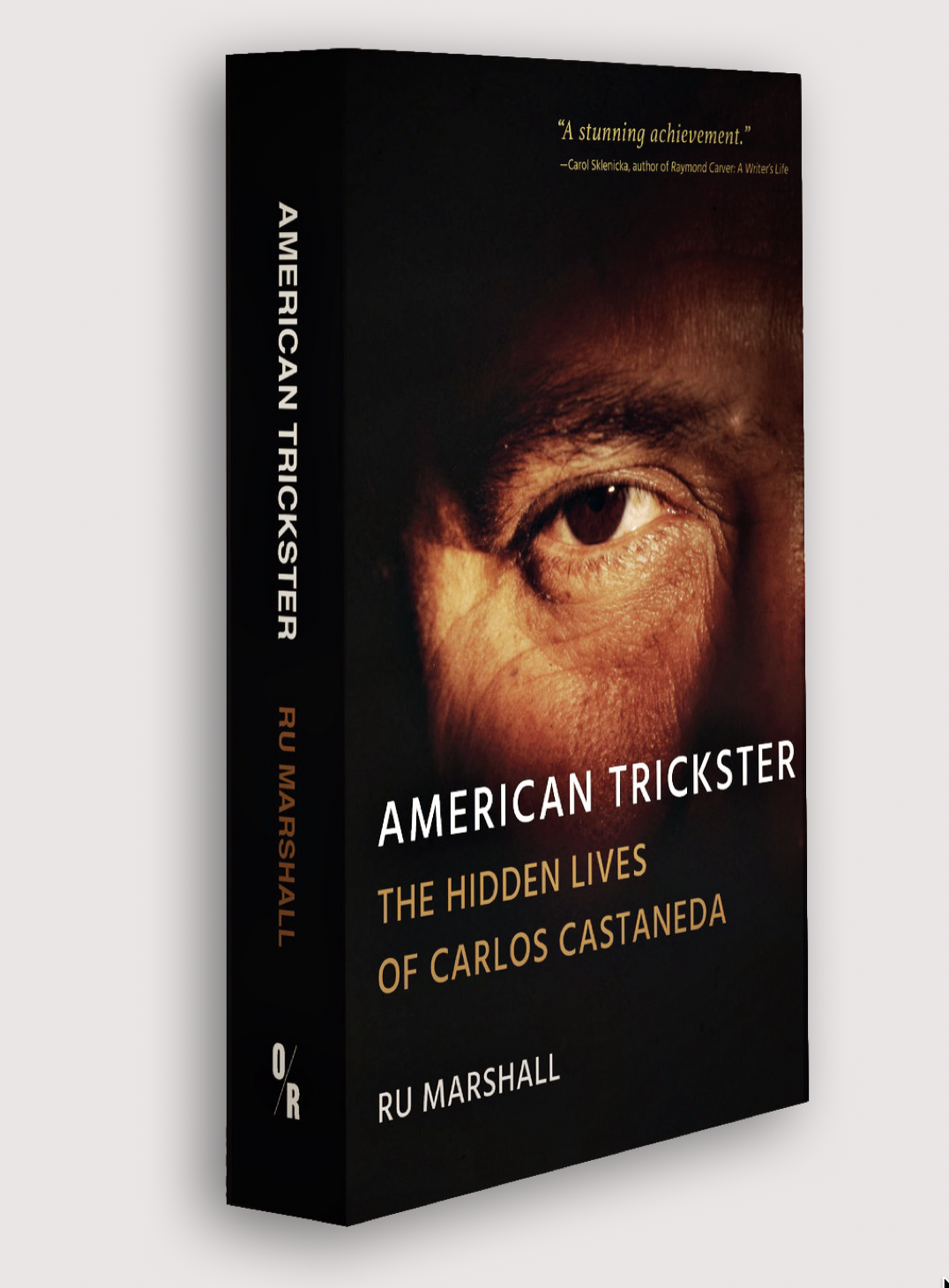
Ru Marshall, American Trickster: The Hidden Lives of Carlos Castaneda. New York: OR Books, 2026.
Review by Don Webb
Frater U∴D∴, notably not a gullible American, asked me to review Ru Marshall’s book American Trickster: The Hidden Lives of Carlos Castaneda. I am not an unknown figure in American esotericism with six books on that rather murky subject and a stint as the High Priest of the (in)famous Temple of Set – noted for calm claims and scholarship. In front of me is a 658 page book purporting to be the biography of César Carlos Salvado Arana Castañeda, born on December 24, 1925 in Cajamatca, Peru – who claimed to be born on December 25, 1935 in São Paulo, Brazil.
Carlitos was a liar, Olympic class. He sold 12 books on “Toltec” shamanism: 11 novels featuring Juan Matus, a half Yaqui, half Yoeme “shaman” who lived in Arizona, Sonora, and Narnia. His 12th book was about ancient Toltec Kung Fu and is supported by videos of tall muscular blonde women showing off their skills at Toltec Kung Fu. The first two novels deal with Carlos’s experiences with datura – we call that “loco weed” in Texas; peyote, we call that “Peyote” in Texas; and “smoking” dried mushroom powder from a hitherto-unknown Sonoran desert variety of psylocibin. The third and fourth novels deal with the non-drug aspects of Carlos’s Initiation. These books sold well – millions of copies in several languages. Sure, “experts” pointed out problems – the Yaqui don’t use drugs, mushrooms don’t grow in the desert, Carlos fails to learn a single non-Spanish term for any of the drugs or practices – but the books were appealing. Millions of us read them. If you were “into” alternative spiritualty of any flavor, you owned them. You’ve seen movies inspired by them from Altered States to Star Wars. Lucas initially described Obi Kenobe as “like Don Juan.”
Why did the books appeal? Firstly, they were exotic – the 70s/80s were in love with the weird. Secondly, it looked good – this wasn’t running into an old hippy at an OTO camp who was on the lookout for young women or men. Thirdly, Don Juan wasn’t asking for cash donations – later Carlos got in the guru game with pricey workshops where he did pick up women – but in the beginning a few bucks at any store where used paperbacks were sold and you were in business. Fourthly, North America was just discovering magical realism – surely Mexico was a magical land. Fifthly (and here is the topper), Americans have little grounding in philosophy: when Don Juan brought us ideas from Heidegger or Sartre or Berkeley (the philosopher not the city), we didn’t recognize them – nor ask why an impoverished Mexican American was spouting them. Now as we grew up, we either ended our romance with esoteric, or found better models. But the root of so much of American pop culture has never been examined. Sure, Carlos has been revealed as a plagiarist, but like L. Ron Hubbard, no one really cared – the books gave us a quick fix when we needed it. But the real story – as my cousin Jack used to say, “just the facts” – is jaw-dropping weird. And finding the life facts of a guy born in two countries a decade apart is a huge effort.
Carlos had a great friend/fan named Michael Harner – a white guy that invented “Core Shamanism”: pretty much the source of every New Age practice sold or taught in North America. Harmer knew a couple of guys in the 1960s: Castaneda and Anton LaVey. LaVey invented a church devoted to the Father of Lies with the slogan “Indulgence not Insistence.” Carlos lectures us against indulgence on every page. Anton taught the road to happiness is finding your own fantasy. Carlos gave you his fantasy. Anton lived on tiny royalties and help from his friends. Carlos lived on millions. The moral? It is better to be the Father of Lies, than just being a friend of the Father of Lies. Carlos throws a bigger shadow than Anton, or Blavatsky, or Crowley. His cultural footprint is huge – and Ru Marshall finally showed us the man behind the curtain. You don’t even have to smoke desert mushroom powder to meet the humbug. Marshall shows his roots both in Western philosophy and the ethnopedology of Harold Garfinkel. And reading this work I realized how many Castenada flavored idea I have held for 45 years even though I rediscovered them in their original sources.
I was a hundred percent blown away by Ru Marchall’s book. As someone that entered the field of American esotericism in the late 1970s/early 1980s, CC’s first three books fit my drugged out, school failing lifestyle to a T. By the fourth book, Tales of Power, in which Don Juan introduced the work of Toltec master Immanuel Kant, I began to be skeptical. By the Second Ring of Power, in which Carlos introduced the idea of having four hot nekkid women helping his superior self, I began to admire him as I had a great deal of difficulty to get two hot nekkid woman to aid me at the same time. By The Eagle’s Gift, when the total had gone up to 16 women, I thought – “Dude, you are phoning it in.” However, I did find more balanced approaches – from less “indigenous“ teachers like Crowley and Gurdjieff, although Crowley did read some of Don Juan’s Toltec sources – notably the Nahuals Nietzsche and Hume and Heidegger. But I loved the novels – all except the one about kung fu. I loved the extra stuff – the witches novels, and Amy Wallace’s book, The Nagual Book of Lists (1992). But I never knew about the workshops, the videos, the harem, the compound, the money.
Ru Marshalls’s book reveals a world that was staggering: Carlos didn’t have a few diehard types that risked their lives seeking the search for truth. He wasn’t Gurdjieff helping his community avoid the Nazis. He wasn’t Crowley piecing together ideas scattered in the Greek Magical Papyri and Kashmiri esotericism. He was that guy you met at a party in college surrounded by red eyed hot girls and a cloud of blue smoke putting out the most outrageous line of BS that you’ve ever heard. But it didn’t end with that party. No one sobered up. It went on for three decades.
Marshall does more than look behind the curtain – he shows you how the wizard made it work. This book is an amazing piece of research and an even more amazing piece of writing. If you are interested in cult phenomena, or in the roots of the “New Age”, you will be enthralled by this study. It answers the never-asked question: “What if Michael Valentine Smith was a real human but said ‚Toltec‘ instead of Mars?” I expect I’ll be re-reading this book every few years until I grok it fully.
Don Webb, author of Overcoming the Old Gods: Aleister Crowley and the Book of the Law. London: Mandrake of Oxford, 2011. ISBN 9781869928650.