All the World a Daemon — ‘The Black Pilgrimage’ by David Beth
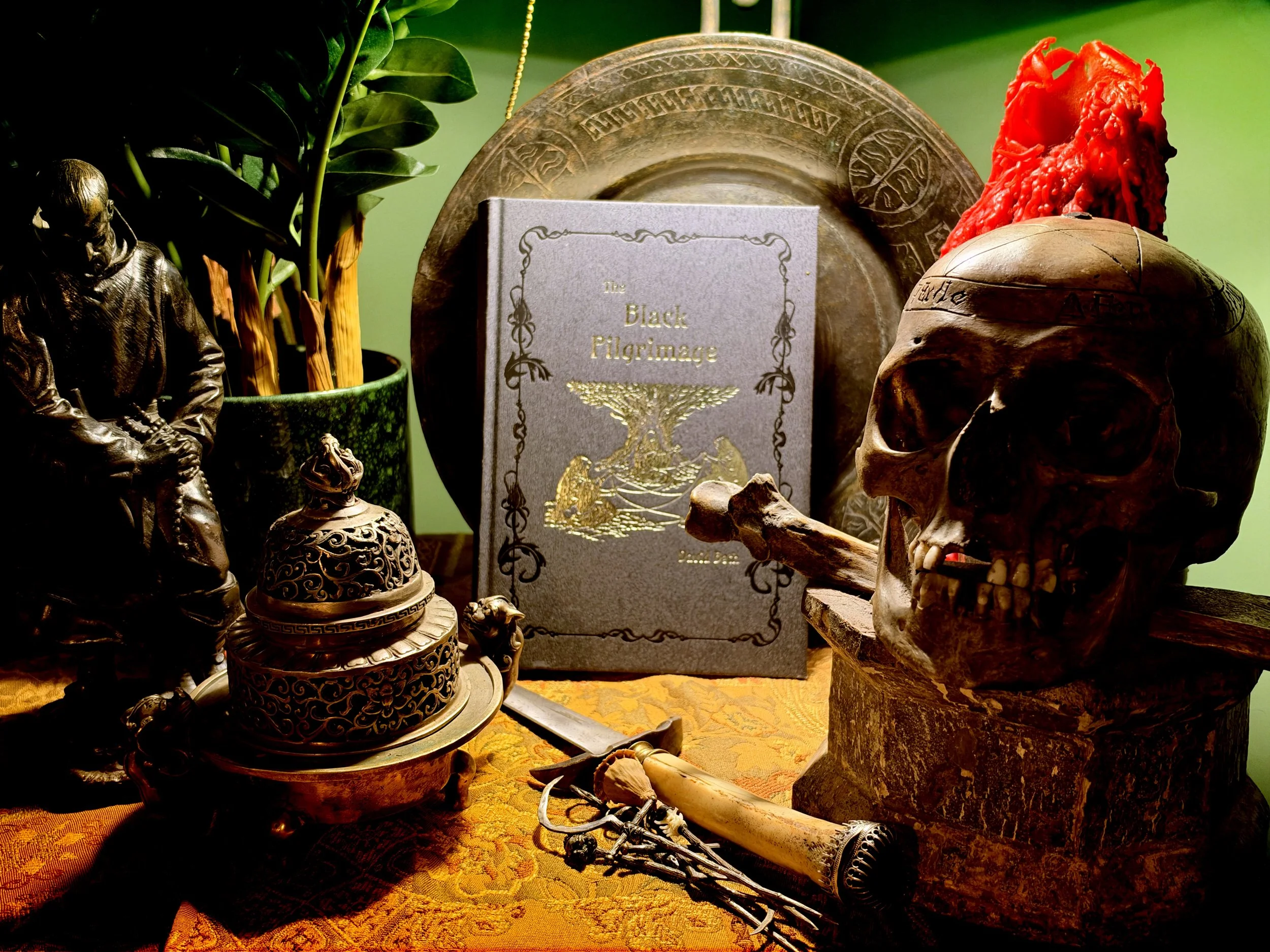
Beth, David, The Black Pilgrimage, Munich: Theion Publishing, 2026.
review by Leni Andersson
All the World a Daemon
I am sitting here while the world falls silent and twilight bathes the marshes in front of my country house in an eerie, pewter light, contemplating David Beth’s The Black Pilgrimage. The reeds have become black strokes against the water; something unseen moves among them, or perhaps the marsh itself is moving toward night. It is the right hour for this book. Not because Black Pilgrimage is “dark” in the decorative sense in which so much contemporary occultism markets darkness, but because its darkness restores depth to a world rendered increasingly transparent, measurable and mute. It asks us to recover a world in which nothing is merely scenery. What unfolds across its pages is a sustained attempt to “recalibrate mortal life toward a deeper Kosmic belonging”.
I have read many books that offer a new metaphysical vocabulary, an alternative pantheon, a reconstructed cult, or an ingenious magical technology. Black Pilgrimage attempts something more radical: it changes the position from which one perceives at all. Its world is genuinely poly-daemonic. River, forest, city, grave, body, mood, season, ancestor and god are presences, agencies, faces of an answering phenomenal All. A tree can be a daemon; a forest another; a landscape yet another, none canceling the others. The sacred is not placed behind phenomena or above them. Appearance itself is theophanic, daemonic, alive.
For Pagan readers, this may be the book’s most important challenge. It is easy enough to adopt an animist or polytheist “worldview.” It is much harder to notice that the one doing the adopting may still be the old monotheistic-transcendental Self: the sovereign observer standing outside the world, selecting beliefs, gods and correspondences. Beth is merciless about this trap. One cannot simply decide to “become animist” while the isolated daylight-I remains enthroned; that only decorates the same cell with more interesting gods. The deeper work is an inversion of sovereignty. The rational-mechanical ego is returned to the role of instrument, while the daemonic Self – plural, relational, embodied, woven from blood, land, powers, injuries and destiny – becomes the living axis.
The Black Pilgrimage is also, quite consciously, an inverted Gnosticism – or more precisely, it takes a genuinely Gnostic diagnosis and reverses its direction. Something has gone profoundly awry in the human condition, but the corruption is not located in flesh, matter or the phenomenal world. It lies in Spirit’s usurpation: the abstracting consciousness that separates itself from the living All and constructs a counter-cosmos in which the sovereign “I” imagines itself observer, judge and master. Where many historical Gnostic formulations sought deliverance from the world, Beth turns that movement inside out. Here the false heaven is abstraction, and the prison is the delusion that we can stand apart from body, death, land, gods and relation. The “Reversal of the Light” leads downward and inward, toward incarnation, participation and deeper immersion in the Kosmos. In Pylon IV (instead of chapters, Beth has “Pylons”) the body becomes “temple and tomb,” and salvation is “not escape but deepening, not ascent but immersion.” This is inner alchemy in the most radical sense: not the inflation of the familiar ego into some spiritualized higher Self, but a transfer of the throne itself — the rational-mechanical “I” becomes servant and instrument, while the Daemon, long dormant in the recesses of the Soul, is awakened and enthroned as the living center of sovereignty.
The first of the six Pylons, “Dark Splendor”, gives us the architecture of this living All. The Kosmos is maternal, pandaemonic and erotic; Magna Mater is not a softened mother-goddess but the fecund and devouring depth that births wolves and infants, harvests and plagues alike. Eros is not sentimental love but the law of relation, drawing beings together without abolishing their otherness. Mater and Eros/Son are neither collapsed into interchangeable symbols nor dissolved into a sterile One. They remain differentiated powers in primordial circulation: depth and relation, bearing and attraction, womb and flame.
Pylon II, “Abyssus Abyssum Invocat”, may be the most demanding section, and perhaps the most beautiful. The Abyss is not a place “below” the world but the world’s groundlessness, its inexhaustible reserve, and the corresponding depth within us by which deep recognizes deep. Beth’s formula – deep calls to deep – becomes less a proposition than a discipline of reciprocity. The pilgrim is not asked to explain the Abyss but to become permeable enough that life can answer it. The language is evocative, at times almost liturgical, yet it points rather than pins down; its names are traces of movement, never definitions of the Real.
Pylon III, “The Poisoner’s Gift”, will be the most controversial for modern individualists, and it should be. Here initiation is not self-certification. The master or mistress is poisoner and midwife, a living threshold whose task is to break the insulated false-I and assist the emergence of daemonic consciousness. Beth refuses to confuse information with transmission and understands how cleverly the spiritual ego can imitate its own overthrow. Whether every reader accepts the initiatic claims is almost secondary; the diagnosis of self-initiation as a potential hall of mirrors deserves serious consideration.
Pylon IV, “Seelenleuchte: Lux Haeretica”, is where the book’s ideas seem to move fully into the body. The “reversal of the light” restores night-consciousness, image, sympathy and embodied participation without asking us to become irrational. Reason is not annihilated; it is dethroned. I found this section, as indeed the entire book, intensely erotic — not because it reduces mysticism to sexuality, but because Eros saturates perception itself. Touch, attraction, distance, decay, longing and recognition become modes through which beings enter relation. The eroticism is ecstatic in the old sense: it carries the self beyond its enclosure. I also responded deeply to the feminine gendering of the adept in these pages: she is neither purified maiden nor passive vessel, but a dangerous daughter of the Abyss, sensuous, intelligent and sovereign in her participation. Elsewhere the book moves freely between masculine and feminine grammatical forms; the practitioner’s gender is ultimately beside the point.
Pylon V, “The Way of the Necropolis”, restores the Dead to the world with unusual seriousness. Ancestors are not psychological residues or sentimental memory but part of the living density in which we exist. Its strength is to show necromancy as relationship, obligation and continuity rather than a sensational technique for obtaining messages. The depth and assurance of Beth’s treatment may also owe something to his initiatory position as a priest of Haitian Vodou, where sustained relations with ancestors and the Dead form a vital part of religious life. The Dead inhabit a maternal continuum spanning soil, dream, stars, blood and place; service to them is simultaneously service to the Kosmos. As someone who has long felt the Dead draw close and speak through the shadows of twilight, their presence unmistakable, I found these pages less like instruction than recognition.
Pylon VI, “Totenbaum: A Meditation on Life within Death”, closes the circle by refusing the modern opposition between vitality and mortality. I first encountered Totenbaum not on the page but in Beth’s own voice, when he presented it at the 2025 Occulture Conference in Berlin. I remember the concentrated silence of a spellbound audience, and the conversations it provoked afterward; a recording of this presentation of Totenbaum is available on YouTube. The coffin becomes womb, seed-pod and “sacred pedagogy”; decay is one of life’s transformative movements. Eros binds creation and dissolution, and the Totenbaum becomes an emblem of a Kosmos continually returning into the Great Mother and arising again in form. The short addendum on fate and destiny then places individual becoming within chthonic necessity: we are neither free-floating consumers of possibility nor puppets, but lives capable of co-weaving destiny through response.
All of this would already make The Black Pilgrimage a profound esoteric treatise, but the book does not leave its vision on the level of words and contemplation. Part Two, “The Work,” gives it ritual body, moving from the dedication of place and vows through prayers and hymns, warding and clearing, openings, transmission, the Black Telesma, renewal and a substantial necromantic sequence. Taken together, these rites form something close to a ritual armory: a rich and demanding body of practice that could become the foundation of a life-long magical discipline. Their sophistication fully matches the depth of the Pylons. These are not the familiar formulae that so often pad out contemporary esoteric books, but carefully constructed operations with density, atmosphere and initiatic intelligence. Some fit naturally into daily devotion; others invite long-term repetition, preparation and deepening. For those who feel the call toward a more formal initiatic path, Beth also makes clear that a further layer of transmission and commitment exists, carrying greater responsibility for both student and initiator.
Beth’s prose deserves attention in its own right. It is intense, incantatory and deeply evocative, at times seeming less to describe a world than to conjure its atmosphere around the reader. Yet it never drifts into sentimentality or decorative excess. The concepts remain precise, and even the most visionary passages preserve clarity of thought; the language amplifies the ideas rather than obscuring them. Its names, images and metaphysical formulations are ways of approaching the Mystery, never substitutes for it. Black Pilgrimage does not ask us to memorize a cosmological scheme so much as to become capable of encounter.
More qualified Magi than this simple practitioner have already appreciated Beth’s opus. Frater Acher has praised The Black Pilgrimage as a magnificent and deeply thought-provoking work, while Peter Mark Adams calls it a defining text of modern esoteric thought and practice. I can add little to assessments of that caliber except the testimony of my own encounter. I consider The Black Pilgrimage one of the most important esoteric books of the last decades, and certainly, for so many reasons, the most impactful occult work I have ever encountered.
I can only offer the voice of a recluse sorceress who has tried all her life, as Beth urges, to remain open to what comes. And what arrived was Black Pilgrimage. It has not given me another worldview to carry around in my head. It has made the marsh outside my window less available to that word “outside.” It has brought the Dead nearer, rendered matter stranger, desire more intense, and the ordinary gestures of a life more meaningful. Like a torch carried into a labyrinth – though its flame is black – it guides me, not out, but further in: deeper into the Gnosis and magic of this daemonic Life.