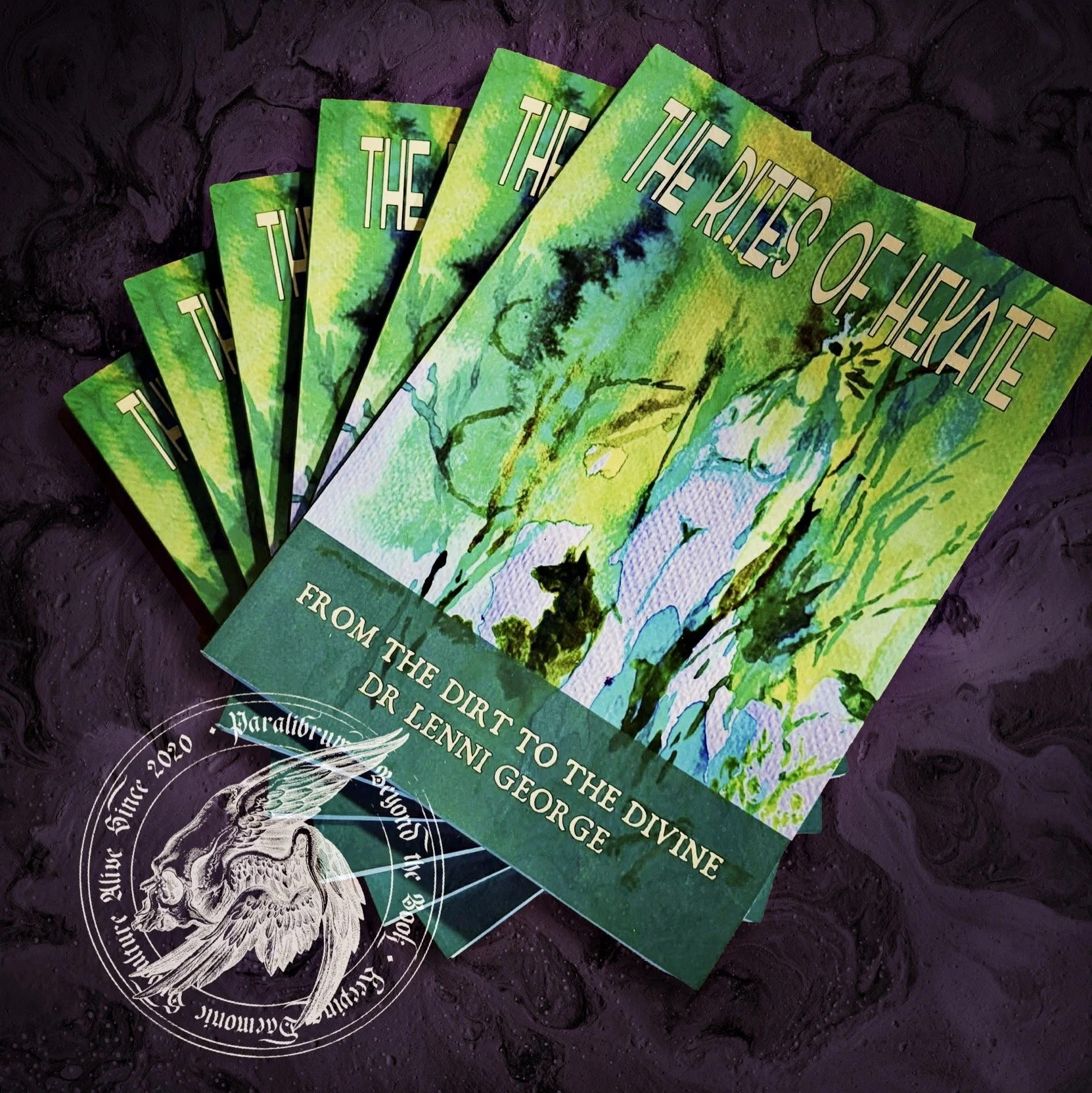
Lenni George, The Rites of Hekate: From Dirt to the Divine, s.l.: Veneficia Publications, 2025
“The prism of history shines with many different hues, leaving it difficult to interpret and understand the real nature and energy you are working with.” — Lenni George
With these words we are introduced to the confessional nature of this interesting, well-structured and profound work by a long-time devotee of the goddess Hekate. I say confessional because unlike so many works on the goddess this one wears its academic rigor lightly, covers the essentials, but moves beyond the formal and the academic to introduce the reader to the world of the dedicated practitioner and to offer a comprehensive, well-balanced program of personal and spiritual development and operative magic within the precincts of Hekatean Craft.
Many readers of this review will be already aware of Lenni George, who, along with Nat Clegg, is the co-proprietor of the successful series of magical and esoterically-themed workshops held at the House of Zophiel, just outside Turin, and at various locations in the UK.
Dr. Lenni George has been a solitary practitioner for over 30 years, and this text is redolent of the depth of her ongoing engagement with the goddess; combining historical research, psychological exploration and embodied practice. The opening chapter, “Walking with Hekate,” describes how the author’s connection with Hekatean themes began with a regression session where she relived a short life on the edge of a witch’s circle; a life characterized by abandonment, poverty and disability. The recovery of this experience – that of the perpetual outsider – subsequently underpinned her solitary approach to the magical path. Reading these words, one has a profound sense of the connectivity and essential continuity existing between past lives and present day lived realities; a continuity that is the hallmark of an inherited magical and spiritual lineage, of being possessed of “witchblood”.
George’s engagement with the material is never merely academic. She identifies as an active herbalist and “potion maker” who views her spiritual path as a journey from “the dirt to the divine.” This unique work is to be commended in its presentation of a structured program of magical work based on two intersecting axes.
The phrase, from “the dirt to the divine,” introduces the first of the two axes that provide the fundamental framework of George’s system. The Vertical Axis (Dirt to Divine) presents a metaphorical ladder that the initiate may climb, both up and back down – for there is nothing “transcendentalist” about George’s approach. Her work remains, at all points, firmly grounded and immanentist – even when exploring the higher octaves of theurgical ascent. The vertical axis therefore encompasses remaining grounded via the practice of “green magic” and herbalism (i.e. the Dirt) at one end, and engaging with celestial and theurgical operations at the other (i.e. the Divine). We will review the herbalism – the “dark botanicals” – shortly, as contrasting starkly with George’s theurgical practice, which rests upon the use of the strophalos (an instrument adopted for both invocation and evocation that is described in the Chaldean Oracles, though better known today as “Hekate’s Top”).
The Horizontal Axis (named “Internal to External”) traverses the space from the practitioner's internal psyche and dreams to external manifestations in the material world.
The intersection of the two axes creates four quadrants of practice:
Earthly Interior (shadow work),
Earthly Exterior (spells and botanical work),
Cosmic Interior (divination and ethical discernment)
Cosmic Exterior (theurgy and formal ceremonies)
This is one of the tidiest, most encompassing and comprehensible models of an “all points” program for magical and theurgical practice that I have ever encountered and the author is to be congratulated for it. Each of the four quadrants provides a variety of practices – rituals and ceremonies, but also community action and academic research – that constitute a comprehensive program designed to achieve a balanced and well-rounded personal and spiritual development within the precincts of Hekatean Craft.
The book provides a variety of rites and rituals, ranging from ancient practices found in the Greek Magical Papyri (PGM) to the author’s modern adaptations. The text prescribes the following major rituals:
1. The Deipnon (Hekate’s Supper): This is the most well-known ritual, marking the end of the lunar month. Its purpose is household purification, veneration, and personal atonement.
2. The Phosphoros Ritual (Light-Bearer Invocation): This modern construction focuses on seeking guidance, clarity, and illumination during life transitions.
3. The Strophalos Ritual (Wheel of Hekate): Used for theurgical practices, divination, and creating magical barriers against spiritual attack.
4. Purification Rites (The Ritual Bath): Used to remove miasma (spiritual contamination) after contact with death, misfortune, or before other magical operations.
5. Kouria Hekates (Hekate’s Provisions): A provisioning ritual to establish a reciprocal relationship with the goddess for active guidance and divination.
6. Botanical and PGM-Based Operations: The text highlights several specific rituals involving “Poisonous Allies” that are used for Divine Revelation and Dream Divination.
A core part of the author’s practice, and her specialty, falls under the heading of “Dark Botanicals.” These encompass a category of plants appropriate for use in Hekatean practice that are defined by their poisonous nature, dark aesthetics, and liminal habitats. These plants are primarily housed in the author's “dark moon garden,” a sacred space created by the author to celebrate the chthonic aspects of Hekate and so dedicated to celebrating the darker side of the goddess. The dark moon garden includes poisonous plants and dark-colored flowers.
All in all, “The Rites of Hekate” is an eminently readable text that provides a comprehensive, well designed developmental framework for Hekatean practice and as such is very much recommended.